I’ve been building software since 2019, after seven years in hospitality. I live in Bordeaux. I’m a co-founder of Front Desk and I work mostly in Python and Rust. I’m currently learning Godot and Blender by building a video game.
Availability and contact
I’m not available for a new position or freelance work.
For a job offer, a partnership, a question about entrepreneurship or a typo, my email is [email protected]. I don’t use social media, apart from LinkedIn. My code is on GitHub.
Experience
Co-founder · Front Desk
Bordeaux · since May 2021, project started late 2019
Front Desk is a communication and coordination SaaS for hotel teams: logbook, maintenance tickets, lost and found, checklists, documents, inventory, multi-property management. More than 500 hotels have used it since it started, including hotels from the Accor, Hilton and Best Western groups. The first hotels in the US and the UK joined in 2026.
There are two of us. I do all the development. We share product, customer relationships and growth.
Engineering
- Software architecture and technical choices.
- Backend in Rust (Axum), public API, API keys and MCP server.
- Frontend in Svelte and TypeScript.
- iOS and Android apps in Flutter: push notifications with Firebase Cloud Messaging, links that open the relevant screen in the app, home screen shortcuts, interface in French and English.
- App Store and Google Play publishing: listings, screenshots, keywords, test builds sent to TestFlight and Google Play automatically with fastlane.
- Docker containers on Scaleway in Paris: continuous deployment with GitHub Actions, monitoring, Sentry on web and mobile.
- Platform security: audits and penetration testing.
Product and customers
- Roadmap and prioritisation, run in Agile with Jira.
- Direct contact with hoteliers: phone, video calls, demos, email support.
- Workshops with hotel teams, to see how they use the product and what slows them down.
- Decisions based on usage data: session recordings and click maps with Hotjar on the old version, PostHog on the new one, Sentry for errors. I use it to choose what each screen puts forward and what gets removed.
- Onboarding for new properties: a getting-started checklist on the home screen, a tips email two days after sign-up, then a message on day six that reads as if written by hand, with no link and no open tracking, asking the manager to reply. It is judged on the number of replies.
- Activation: a property has really started when an entry written by one person is read by someone else. The team screen flags accounts that have never logged in and lets the manager resend access. A password written on a scrap of paper often gets lost between shifts.
Acquisition and visibility
- The marketing site, built with Astro, in French and English, with about forty pages per language.
- Search optimisation for Google and for AI assistants such as ChatGPT, Claude and Gemini. I researched the questions receptionists and managers ask, then wrote one page per topic (logbook, shift handover, out-of-order room, no-show, security occurrence book), with FAQs and structured data. Front Desk ranks first on Google for hotel logbooks in French, and these assistants cite it in their sources.
- Free templates to download as PDF and Excel (logbook, shift handover, lost and found register, room cleaning checklist, cash-up sheet, rooming list) and a guide to AI in hospitality.
- In 2026 I rebuilt the home page around a hotel team’s day. Hotel sign-ups went up 40%. About a quarter of these new hotels still use Front Desk.
- An online presence kept up for six years: the company LinkedIn page, with more than 2,200 followers, Instagram, the Google Business profile and our personal accounts.
- Partnerships with PMS vendors (hotel management software) and other players in the industry, and startup events.
- At launch, we presented our application to a Bpifrance committee, which granted us €30,000.
Main projects
- 2019 to 2021. First web platform in Django and Bootstrap, then a version with a Django REST Framework API and a React frontend. Continuous integration and error tracking with Sentry.
- 2022. First iOS and Android mobile app in Flutter.
- 2026. Full rewrite of the platform, from Django and HTMX to Rust (Axum) and Svelte, with new infrastructure. Response times dropped sharply, server costs fell by 40 to 60% and there are far fewer bugs in production. I wrote about it in two articles, in French: why and how.
- 2026. Mobile apps rebuilt from scratch on the new API.
- 2026. Public API, API keys and an MCP server, so Front Desk can be connected to assistants like Claude or ChatGPT. Front Desk is available in the ChatGPT marketplace.
- 2026. The site and the app are available in English.
- 2026. A fictional hotel whose three staff members are played by an AI. Every three days the agent creates logbook entries, tickets and comments, and documents any anomaly it runs into. It complements unit, integration and end-to-end tests on situations they don’t cover.
Software Engineer · Fieldbox
Bordeaux, hybrid · since February 2025
Client assignments and internal projects: architecture, backend and fullstack development, helping product teams with delivery.
- RATP Dev, tech lead on AI projects. Architecture and practices for Django, Streamlit and React applications. Code conventions and project structure so they stay maintainable. Advice to the product team on backlog and design, client presentations.
- RATP Dev, fullstack lead on a data governance platform. Design and development of a data quality tracking platform in Django, Snowflake and Svelte. Interface design, backlog prioritisation and client presentations. Details are in the work section.
- Oil industry, equipment maintenance on an FPSO. Backend and React/TypeScript frontend for an application that tracks equipment state and history, with an event-driven architecture.
- Internal projects. Backend development on three projects, advice on design patterns and good practices.
I also helped Fieldbox move to AI agent-assisted development: internal talks, guidelines, plugins and skills for the teams.
Backend developer · CGI
Toulouse, hybrid · April 2024 to January 2025
Backend reinforcement for Airbus and Veolia, in a Scrum team of about twenty. API development and optimisation with FastAPI, Django and Django REST Framework.
Fullstack developer · Julia
Paris · May to August 2021
Work on Django applications, asynchronous processing with Redis and Celery. Frontend integration (HTML, CSS, AngularJS, jQuery) and the start of a migration to React.
Receptionist and barman · Hospitality
France and UK · until 2019
Seven years in two to four star hotels, in Paris and in the UK. Receptionist, a year behind the bar, then senior receptionist at the Ibis Paris Gare du Nord La Fayette (Accor). Guest relations, front desk and food and beverage procedures, helping new team members.
Work
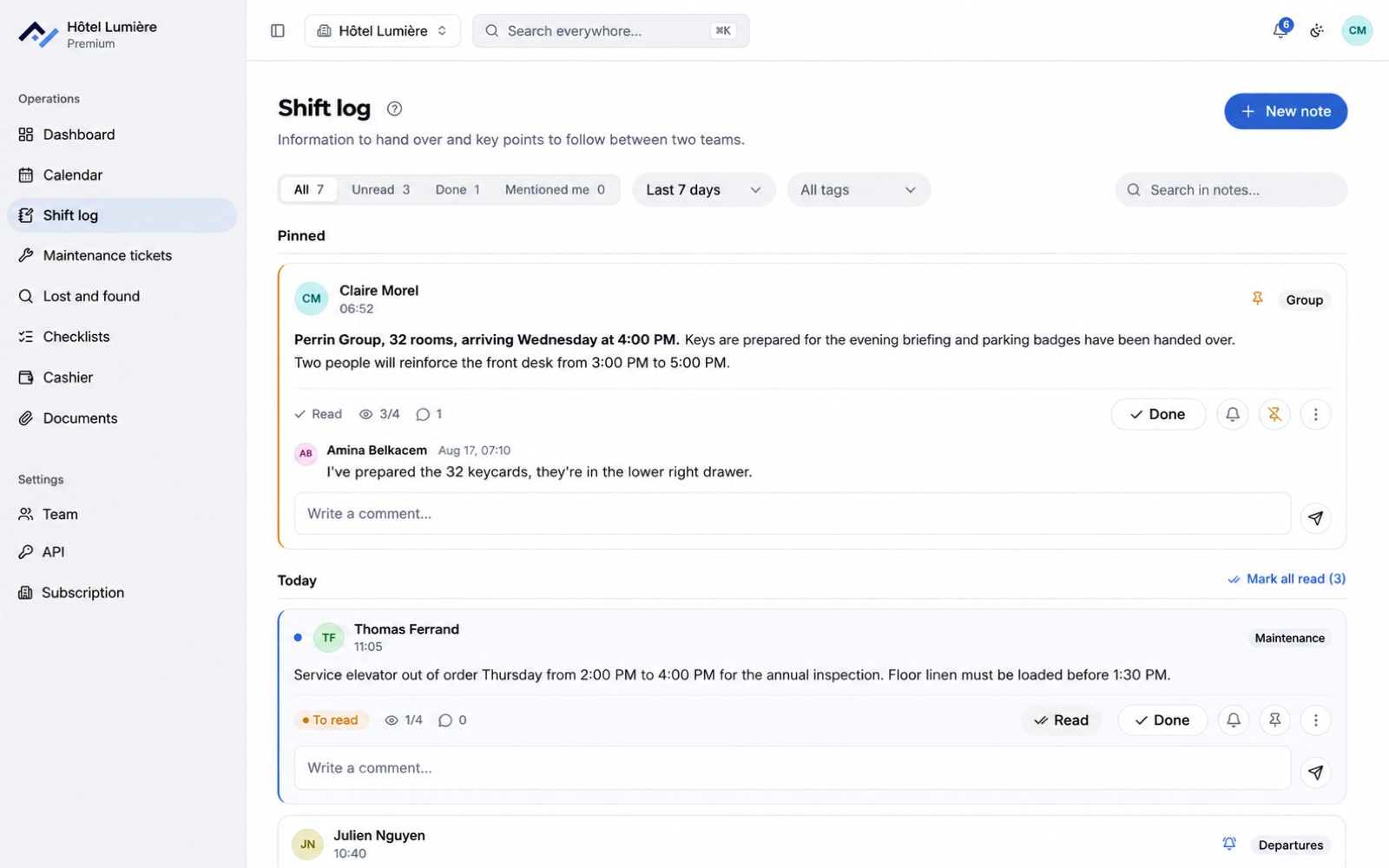
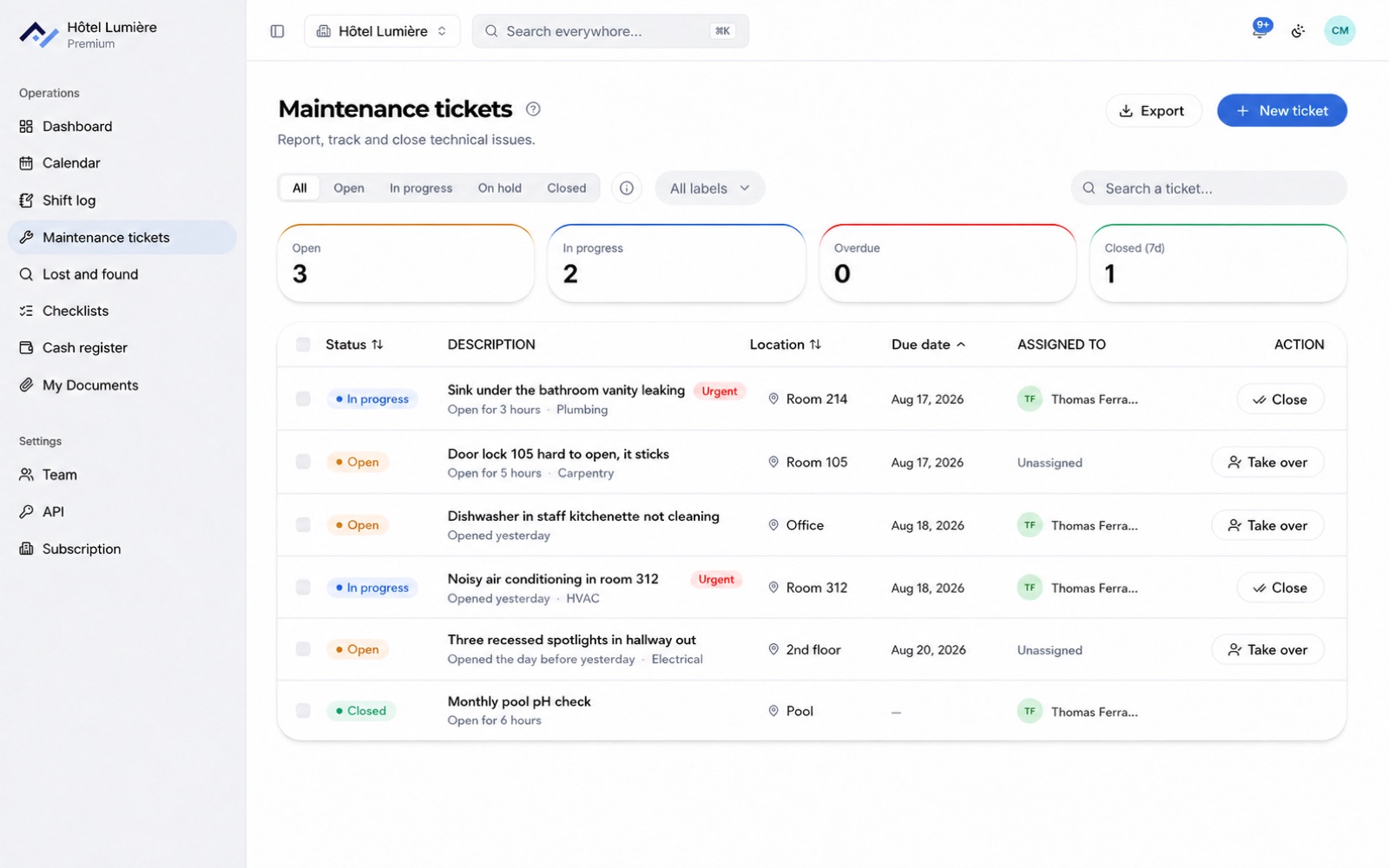
Front Desk, web app
The logbook and maintenance tickets, in the version rewritten in Rust and Svelte in 2026.
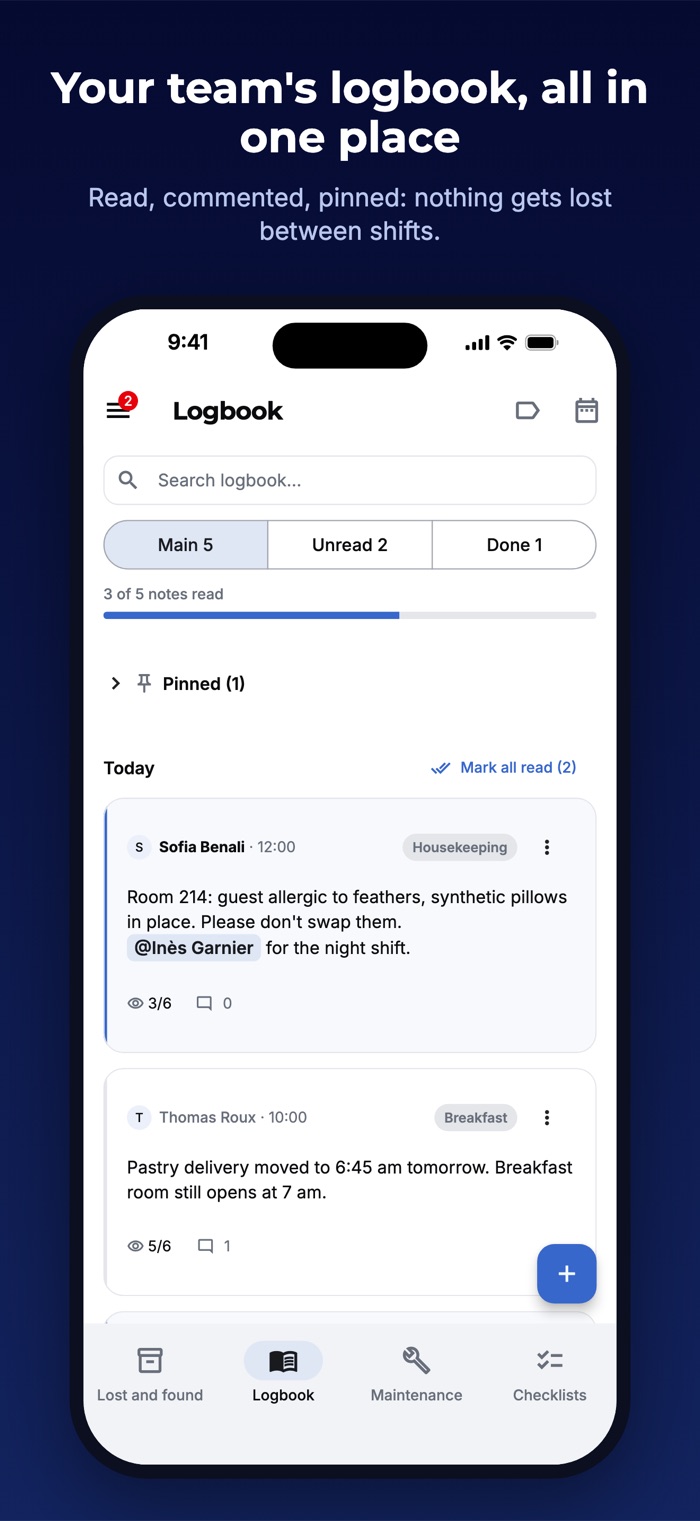
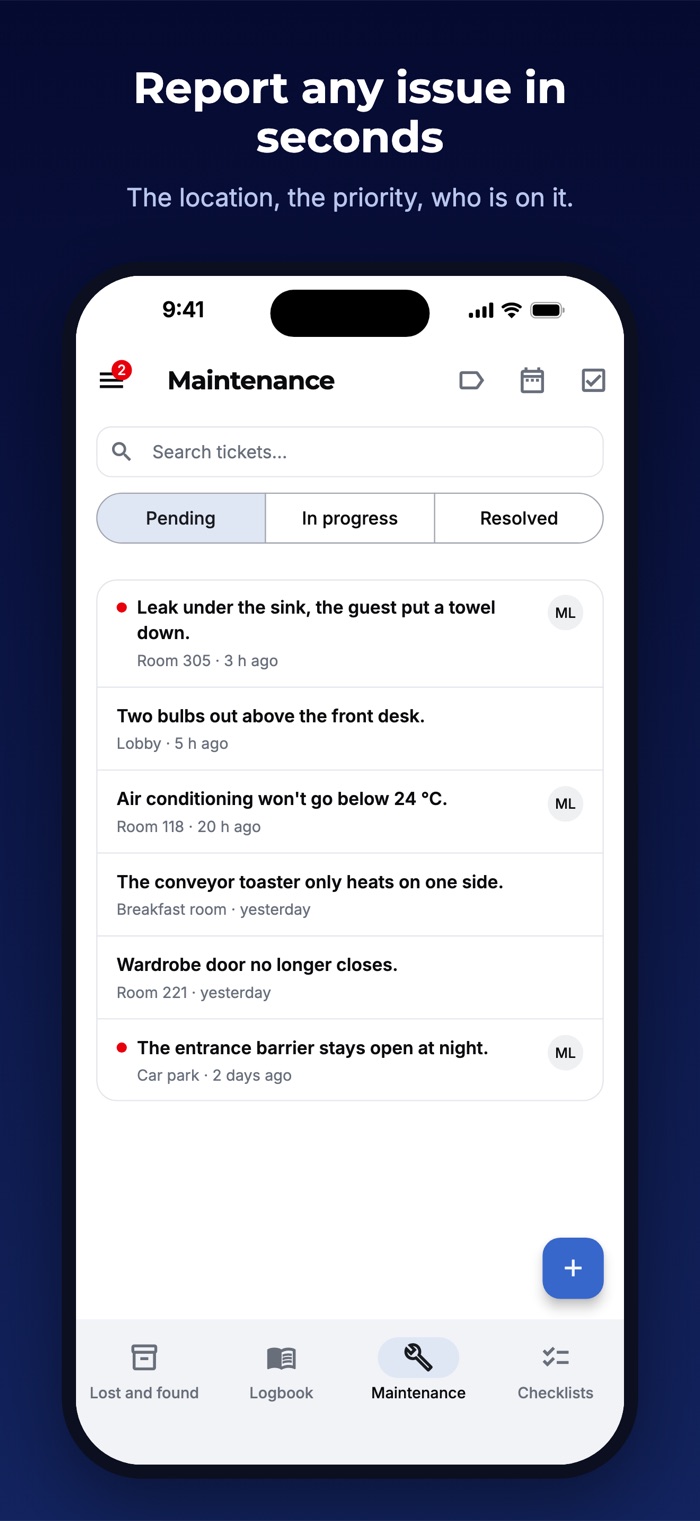
Front Desk, iOS and Android apps
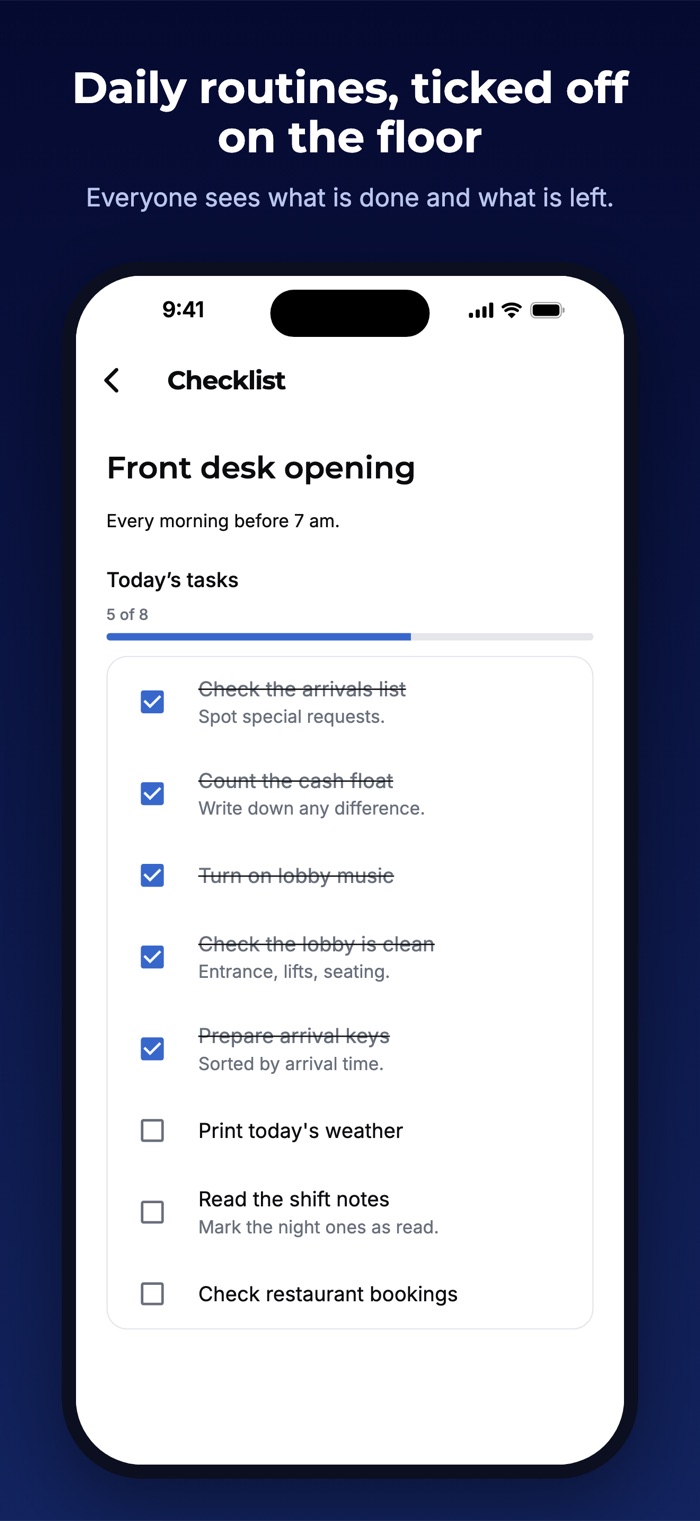
The mobile apps offer the same tools and are built with Flutter. The screenshots come from the App Store listing.
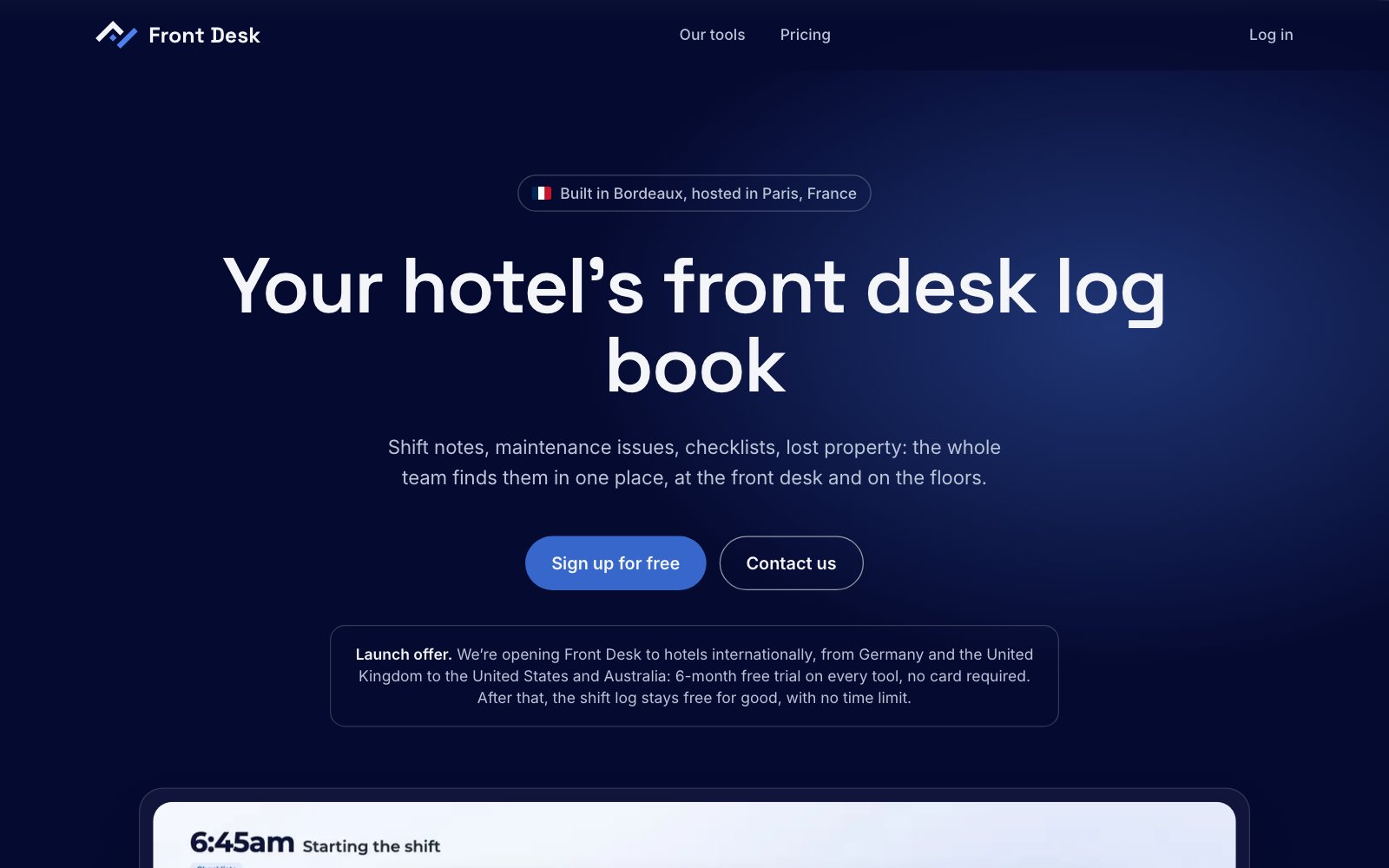
Front Desk, marketing site
The front-desk.fr site, built with Astro, in French and English. I designed and wrote it, and I work on its search ranking on Google and in AI assistants. The home page follows a hotel team’s day, from the start of the shift to the end of service.
Data governance and quality platform
Fullstack lead · on assignment for a large multi-subsidiary group · since September 2025, in production since January 2026
A web application that gives a large group’s data teams a view of their data quality: the catalogue of tables and fields, the business glossary, the quality checks and their results, by dimension, subsidiary, domain and source system. The checks run in a quality engine inside the data warehouse. The application reads their results and displays them. It never computes a verdict, and that rule shapes everything else.
I designed and built the application end to end, backend and frontend, and I present each release to the client. I work with a product owner, a data team and the subsidiaries’ data managers, who are the users.
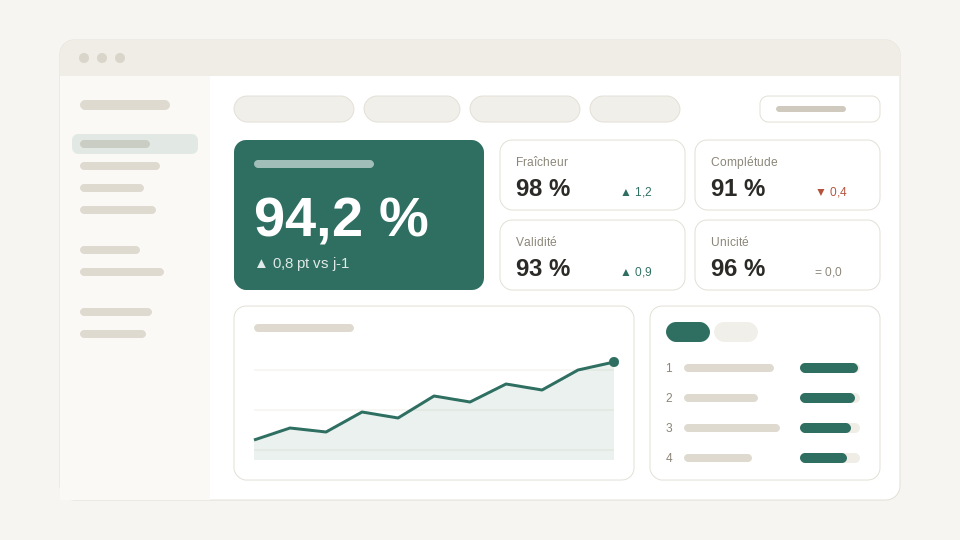
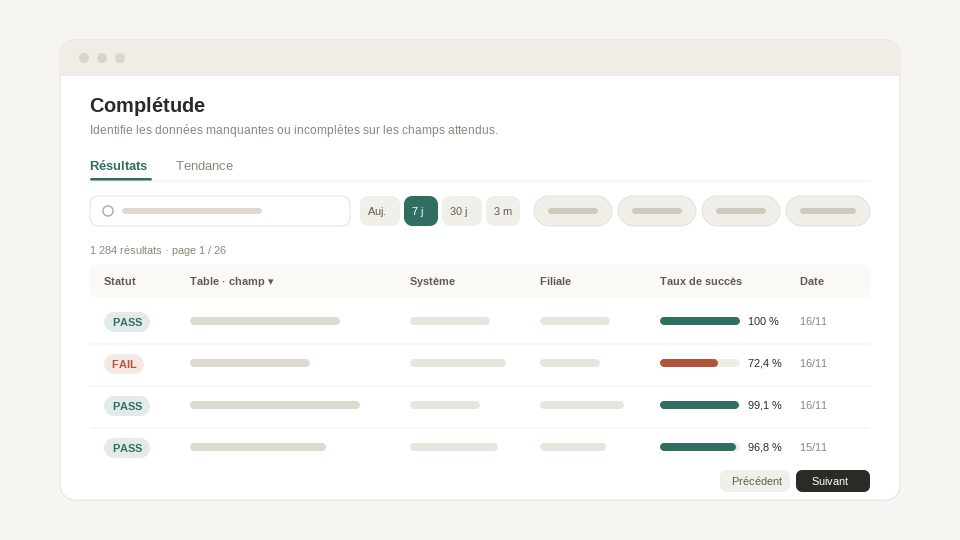
Mockups of the application, recreated without any real data or names. The interface is shown in French.
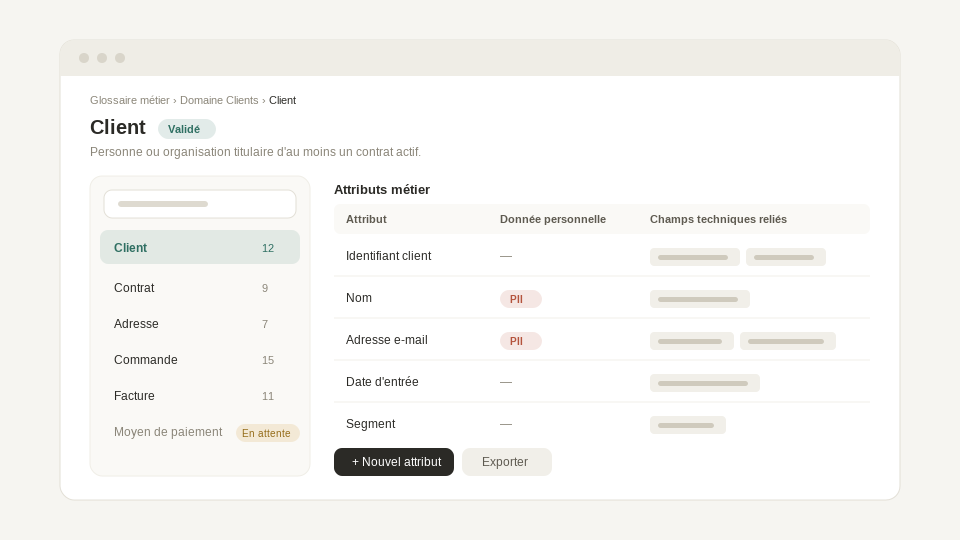
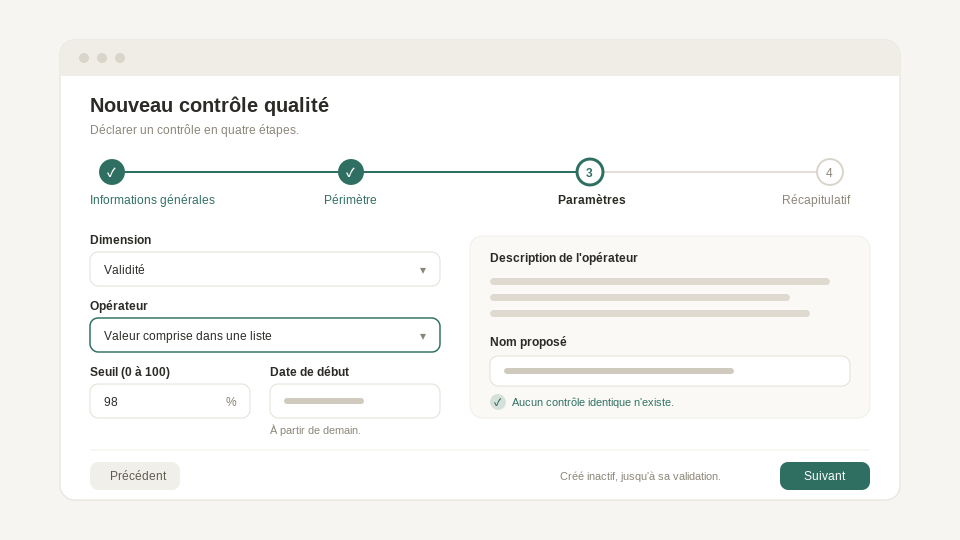
Engineering
- Backend in Django 6 and Django REST Framework, with PostgreSQL. Snowflake stays the single source of truth: results are imported as they are, incrementally, with no transformation.
- An integrity rule proven by tests rather than written in a document. A test scans the source code and fails if any other part of the application writes a quality verdict. A missing measurement shows as empty, never as 0%.
- The engine runs several times a day on the same table. The application always keeps the day’s latest run, in the API, the charts and the emails.
- Declaring checks from the interface: a four-step wizard creates the check, inactive until approved, then sends it to the data warehouse, where the engine picks it up.
- Frontend in SvelteKit, Svelte 5 and TypeScript, with Tailwind and shadcn-svelte. A static application that displays what the API returns: filters, sorting, pagination and aggregates are computed by the server.
- A screen’s whole state lives in the URL: search, filters, period, sorting, page. A shared link reopens exactly the same screen, and it is the most reliable way to reproduce a reported problem.
- Permissions by role and by scope: subsidiaries, products and sub-domains combine on every result displayed. Single sign-on through the company directory, with no login form.
- Email digests: a user subscribes to a check, and a data manager can subscribe their colleagues.
- A read-only MCP server, to query the glossary, the catalogue and the quality results in natural language from an AI assistant.
- AWS infrastructure: containers on ECS Fargate, RDS, S3, Secrets Manager. Continuous deployment with GitLab CI, with each feature branch deployed automatically to a development environment.
- Unit, integration and end-to-end tests with pytest, vitest and Playwright. A single command runs every backend and frontend check, and a hook runs them again before each push.
- Interface in French and English, light and dark theme.
Product and users
- Backlog, prioritisation and a presentation of each release to the client.
- About fifty releases shipped in a little over a year, each with release notes written for users and shown in the application.
- Built-in help that answers the questions support kept getting. The first one: a newly created account has no role yet, so it sees no quality results. It now lands on the glossary, and the screen tells it who to contact.
- The home screen answers one question: what is the data quality level on a given day? An overall score, four dimensions (freshness, completeness, validity, uniqueness) and their change since the day before, then the best and worst rated sub-domains and source systems. Clicking a row turns it into a filter, to see which dimension drags it down.
- Regular audits of the interface, the API and the code, whose findings feed the backlog.
Main projects
- September 2025 to January 2026. First version in Django and HTMX, in production in January 2026: dashboard, results by dimension, technical catalogue.
- Early 2026. Business glossary, check creation wizard, cascading filters, permissions aligned with the client’s role matrix, admin portal.
- Spring 2026. Access scope by product, check subscriptions, glossary import and export, fully translated interface.
- September 2026. Complete rewrite of the interface, from HTMX to a SvelteKit application built on the API.
- October 2026. Declaring checks and editing the glossary from the new interface, global search, subscribing colleagues to digests. Quality screens become three to ten times faster for a user limited to a few subsidiaries.
- Throughout the project. AI agent-assisted development, guided by rules and skills versioned with the code: one skill per recurring task (new screen, new feature, end-to-end tests, translation, release, incident follow-up).
BEGINNING, a game in progress
A low-poly 3D city-builder with an isometric view. A family joins the fire of a Natufian tribe and gradually takes charge of the village, then its lineage moves through the ages up to the Iron Age. Villagers choose their own work, and the player decides where to build.
I’m learning Godot 4, GDScript and Blender on this project. I handle the design, the game loop, the 3D models and all of the code. AI acts as a mentor: it asks me questions, points me to the documentation when I’m stuck and reviews what I write.
Skills
- Product. Seven years on Front Desk, from the first version to a full rewrite. Roadmap, backlog structuring and prioritisation, delivery, user workshops.
- Interface design. UI and UX design, based on session recording analysis, Jakob Nielsen’s ten heuristics, online courses and books such as Don’t Make Me Think, The Design of Everyday Things, Refactoring UI and Laws of UX. You’ll find them on my reading page.
- Usage data. PostHog, Hotjar and Sentry to track activation, user journeys and errors.
- Acquisition. Search optimisation for Google and AI assistants, pages and free templates for hoteliers, email onboarding with Brevo, presence on LinkedIn and Instagram.
- Customer relationships. Demos, support, help with setup, by phone and video call. Seven years behind a hotel front desk before that.
- Entrepreneurship. Bpifrance funding, partnerships with industry vendors, startup events.
- AI. Agent-assisted development, MCP servers, assistants connected to a product, plugins and skills for teams. Put into practice in hospitality with Front Desk and in transport with RATP Dev.
- Languages. Rust, Python, TypeScript, JavaScript, Dart.
- Backend. Axum, Django, Django REST Framework, FastAPI, Celery, event-driven architecture.
- Frontend. Svelte and SvelteKit, React, HTMX, Astro, Streamlit.
- Mobile. Flutter for iOS and Android, Firebase Cloud Messaging, App Store and Google Play publishing with fastlane.
- Data. PostgreSQL, Redis, Snowflake.
- Infrastructure. Docker, Linux and Ubuntu, Scaleway, AWS (ECS Fargate, RDS, S3, Lambda), continuous integration with GitHub Actions and GitLab, Sentry, monitoring and observability. Setting up and securing servers.
- Network and self-hosting. Setting up and securing a network with Ubiquiti hardware and a NAS, self-hosted services with Docker. I wrote about it in this article.
- Security. Audits and penetration testing with OWASP ZAP and Burp Suite.
- Method. Agile and Scrum, Jira, unit, integration and end-to-end testing.
- Game development. Godot 4, GDScript, Blender, currently learning.
A few articles
- Why I Chose HTMX Over React and VueJS, with a 2026 update on why I changed my mind.
- Django Best Practices: Lessons from 6 Years Building a Large-Scale SaaS
- Three Years of AI Assisted Programming
The rest are on the articles page.
Education
- Application developer, Python track · OpenClassrooms, 2019 to 2021. Level 6 diploma (bachelor’s level), awarded March 2021. Requirements analysis, UML design, Django, databases, testing, continuous integration, technical documentation.
- English for Hotels and Catering (B1) and General English (B2) · WE Bridge Academy, Cardiff, 2013.
- First aid certificate · 2014.
- CQP Hotel receptionist · Stephenson Formation, 2011.
Languages and driving licence
French, native. English, fluent and used at work. Basic Spanish.
Full driving licence (category B).
Recommendation
Gaëtan is an excellent developer. He can come up with solutions and carry complex projects through to the end. A real asset in a dev team!
Lionel Duroyon, senior Python backend engineer, October 2024 (translated from French).